


Cookies help us deliver our services. By using our services, you agree to our use of cookies.
Pre-Season Fitness - How to Get Ready for the New Football Season
By the end of July, most Sunday league players are feeling the same combination of guilt and optimism. Two months of doing very little — a bit of walking, maybe some garden cricket - followed by the slow realisation that the new season is five weeks away and the last time you ran properly was the final match in May.
Pre-season for amateur footballers doesn't need to be brutal or complicated. It needs to be progressive, consistent, and realistic about where you're starting from. Here's how to approach it.
Start Honestly
The first thing to accept is where your fitness actually is, not where you think it should be after a summer break. Going from nothing to hard running in week one is the fastest route to a pulled muscle that puts you out for the first month of the season.
If you've been reasonably active over summer - cycling, swimming, walking regularly - your base is probably fine and you can move through the early stages fairly quickly. If you've done very little, give yourself an extra week at the beginning before you push intensity.
Weeks One and Two: Get the Engine Running
The first two weeks are about base fitness - getting your cardiovascular system working again without stressing your muscles and joints too hard too quickly.
Three or four runs per week at a comfortable pace - a pace where you could hold a conversation if you had to - is enough to reactivate your aerobic base. Distance matters less than time at this stage. Twenty to thirty minutes is plenty. The goal is consistency, not speed.
Alongside running, basic bodyweight exercises - squats, lunges, press-ups, core work - reactivate the muscle groups you'll need on the pitch. Football places significant demand on your quads, hamstrings, glutes, and calves. A 15 to 20 minute circuit three times a week alongside your running covers the strength element without adding too much load.
Weeks Three and Four: Add Football-Specific Work
Once you've got a base, start introducing the things that actually make you fit for football rather than just generally fit.
Interval running. Football involves repeated short sprints separated by lower-intensity movement. Train for that, not for sustained distance. A simple session: warm up for 10 minutes, then alternate 30 seconds of hard effort with 90 seconds of easy jogging, repeated eight to twelve times. This is significantly more football-relevant than a steady 5km.
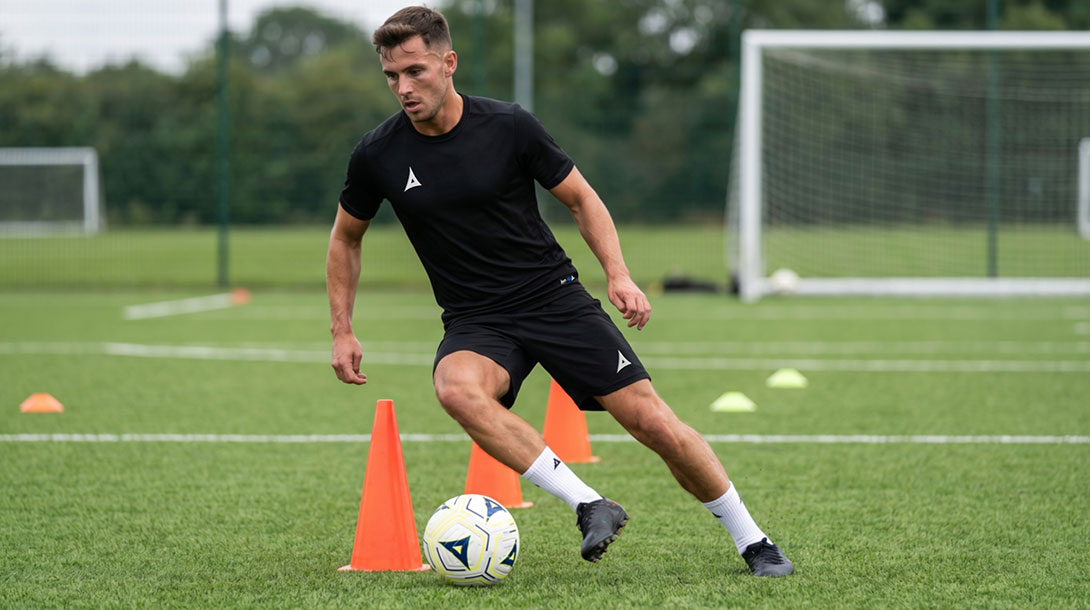
Change of direction. Straight-line running doesn't prepare your joints and muscles for the sideways cuts, sudden stops, and pivots that football demands. Add agility work - shuttle runs, cone drills, lateral movements - into your sessions.
Ball work. If you can, get a ball involved in your pre-season fitness sessions. Dribbling at pace, shooting after a run, passing and moving - football fitness with a ball is more effective than gym work alone, and it reminds your touch that it's needed again.
Weeks Five and Six: Build Match Sharpness
The final two weeks before the season should focus on match-intensity work. If your club is running pre-season friendlies or small-sided practice matches, these are more valuable than any solo fitness session. The starts, stops, collisions, and sustained intensity of a real game cannot be fully replicated in training.
If your club's pre-season is lighter than this, organise informal small-sided games with teammates. Even 30 minutes of competitive five-a-side once or twice a week in this period is enough to sharpen match readiness.
Reduce solo running volume in this phase - you've built the base, now trust it. Save your legs for the match intensity work.
Don't Forget Recovery!
Pre-season is when most amateur players pick up the niggles and soft tissue injuries that follow them into the season. The reason is usually the same: they go from nothing to hard training too quickly and don't recover properly between sessions.
Sleep is the most important recovery tool available to you. Eight hours makes a bigger difference than any supplement or ice bath.
Hydration matters more during pre-season than mid-season because you're training harder in warmer weather. Drink more water than you think you need, particularly in the two hours before and after training.
Foam rolling and stretching aren't the most exciting parts of a training session, but if you're managing a recurring hamstring problem or tight hip flexors, ten minutes of mobility work after training genuinely helps.
Kit Ready for the New Season
Pre-season is also the right time to sort your kit before the new season starts rather than scrambling a week before the first fixture. If your training kit is due a refresh, the Evolve Pro Range covers everything from Training Tees, Shorts and Socks to Hoodies and Jackets.
For training in cooler pre-season morning sessions, a good Baselayer makes a significant difference to how comfortable your warm-up is before your body temperature rises. And if your club is ordering new match kit for the season, getting that sorted in the pre-season window, giving you enough time to recieve delivery and sort the kit for the new season.
Take a look at the full Teamwear Collection or get in touch if you need assistanace ordering for a full squad.